Before we begin, I wrote this after noticing something at a restaurant I visited some years ago. An F&B outlet supervisor remembered what I usually ordered, and reserved the last portion for me the day it sold out. It was a small thing, but I couldn’t stop thinking about how many decisions had to be made, years before that day, by people who never met me, for that moment to be possible. This is my attempt to trace that chain backward.
Organizations seeking to improve HR come across an expanding landscape of ideas and a wide range of choices. These range from operating models, organizational structures, technologies, and management philosophies to approaches such as employee experience, AI, and strategic HR. As organizations respond to changing business needs and continue refining their HR systems, choosing among these approaches becomes an important part of HR design.
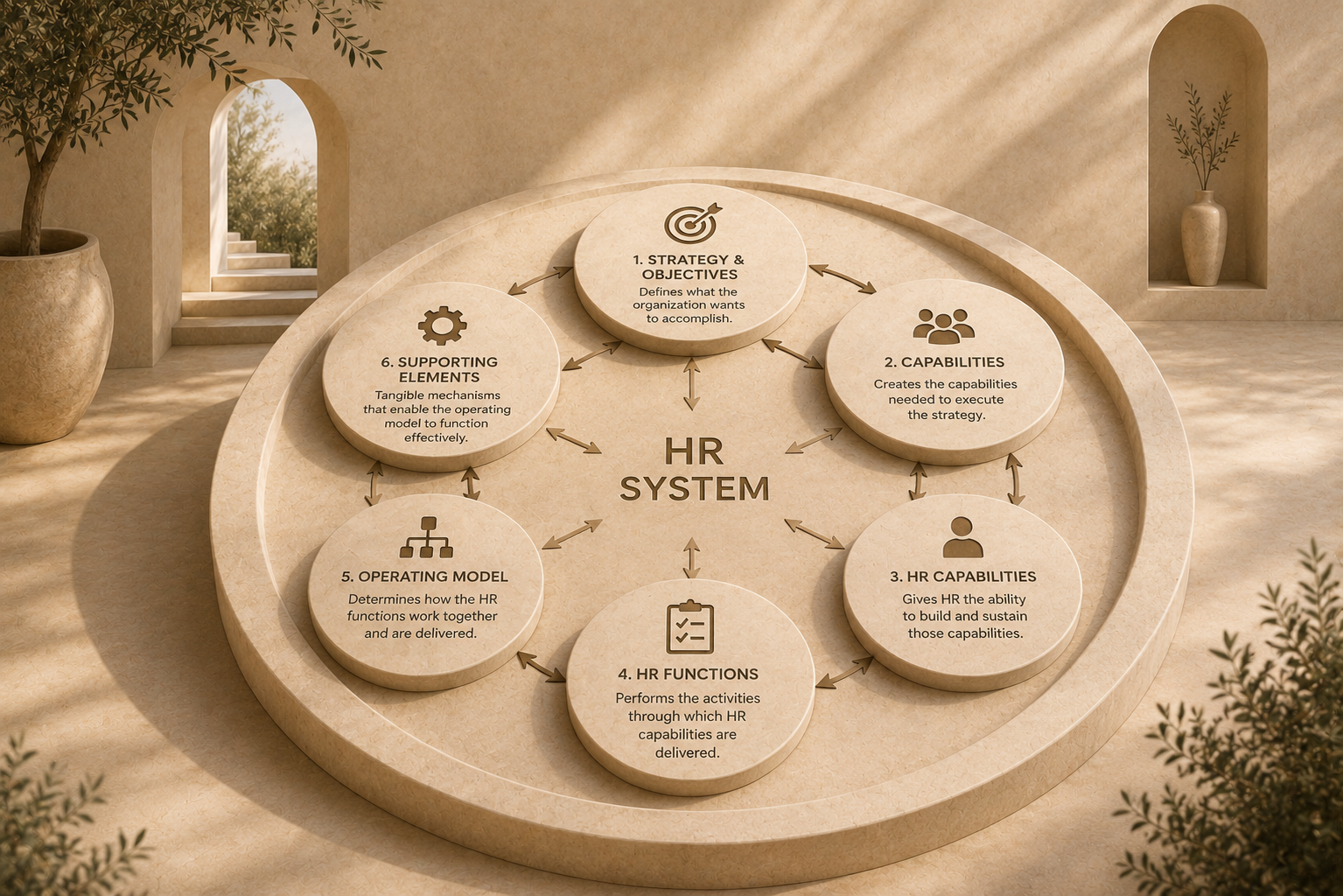
Designing HR involves more than choosing among these approaches. It requires understanding the different elements of an HR system and the role each plays in supporting the organization’s objectives.
In order to choose and implement the most appropriate approach, an organization first needs a clear understanding of where the business is going and what it intends to achieve. That understanding begins with its strategy, the culture it is trying to create, the capabilities it must build, the workforce it needs, and what it is ultimately trying to achieve.
HR then identifies the capabilities required to support those objectives. These may include the ability to recruit talent, develop leadership pipelines, respond quickly to changing workforce needs, maintain compliance, retain employees, or use workforce data to improve business decisions.
Those capabilities are delivered through HR functions. The organization’s workforce gives rise to a wide range of responsibilities. People need to be recruited, onboarded, developed, compensated, evaluated, promoted, supported, and, where necessary, disciplined. Teams collaborate, disagreements arise, leaders are appointed, careers progress, regulations must be met, and workforce decisions need to be made. HR functions provide the organizational mechanisms through which these responsibilities are managed.
Under HR functions, you will commonly find areas such as workforce planning, talent acquisition, onboarding, learning and development, performance management, compensation and benefits, employee relations, compliance, leadership development, succession planning, organizational development, HR technology, and workforce analytics. Organizations may define, combine, or name these functions differently according to their needs, although each contributes to the capabilities required to support the organization’s objectives.
Having these functions, however, does not by itself create an effective HR system, just as assembling the right ingredients does not by itself produce a successful meal. Two functions can each work well on their own and still not support each other. If recruiting hires people who take initiative, but performance reviews reward people who simply follow instructions, the system ends up discouraging the very behavior it intended to recruit. So, the quality of the meal depends on the recipe, because it determines how those ingredients come together to produce the intended meal.
An effective HR system also depends on how those functions are organized. That is the role of the HR operating model. It organizes and integrates the HR functions so they collectively support the capabilities the organization needs. Different organizations may perform many of the same HR functions while organizing and delivering them in very different ways according to their business needs.
The most appropriate operating model depends on the organization it is intended to support, including how much the organization can afford to spend, and how much its current systems and processes would need to change to support something different. The organization starts by deciding what it wants to achieve. Everything else, including the capabilities it needs, the HR functions it builds, and how those functions are organized, follows from that decision. The following example traces that logic through a single customer interaction.
Consider an organization with a strategic objective of improving customer experience.
Over several visits to the organization’s restaurant, a guest regularly stopped at the F&B outlet afterward and ordered the same meal each time. One day, the meal sold out earlier than expected. Having noticed the guest’s ordering pattern over previous visits, the F&B outlet supervisor asked the kitchen to reserve one portion before it was gone. As the guest approached the serving counter, the supervisor explained that although the meal had sold out, a portion had been set aside because they knew it was the guest’s preferred choice. To the guest, it felt like an exceptional act of personal attention.
That interaction began before the supervisor recognized the guest. It was embedded in the design of the organization’s HR system, which helped create an environment where employees noticed guest preferences, had the authority to act without unnecessary approval, and were encouraged to use their judgement.

1. Business Strategy & Objectives: The organization decided that customer experience would be a source of competitive advantage. HR system was designed to reinforce that objective.
2. Organizational Capabilities: Delivering that objective required the organization to become consistently capable of anticipating customer needs, empowering employees to exercise judgment, collaborating across departments, and delivering a consistent service experience.
3. HR Capabilities: Building those organizational capabilities required HR to develop its own capabilities. HR needed to identify people with strong customer orientation, develop service excellence and decision-making skills, reinforce customer-focused behaviors, and evaluate whether those behaviors were becoming part of everyday work.
4. HR Functions: Those HR capabilities were built through a range of HR functions.
- Talent acquisition designed interview questions that showed whether candidates naturally noticed customer needs.
- Onboarding introduced new employees to the organization’s service philosophy.
- Learning and development equipped supervisors to anticipate guest preferences and exercise sound judgment.
- Performance management reinforced behaviors such as initiative, collaboration, and personalized service.
- Recognition programs celebrated employees who created memorable customer experiences.
- Organizational development strengthened collaboration between the restaurant, F&B outlet, and kitchen so employees worked toward the same customer experience.
5. HR Operating Model: The HR operating model determined how HR organized and delivered its services across the organization. Some organizations embed HR locally within teams, so decisions can be made close to the people affected by them. Others centralize HR around specialist expertise. Others standardize HR through shared, common processes delivered consistently across the organization. Each approach comes with different strength and limitations, and the right choice depends on what the organization needs.
In this above case, the operating model needed to support local judgment, allowing decisions to be made close to the guest rather than relying on unnecessary escalation. The operating model ensured that recruitment, onboarding, learning, performance management, and employee support worked together to develop employees who consistently anticipated and responded to guest needs.
6. Supporting Elements: The supporting elements allowed the system to operate consistently.
- Governance gave supervisors the authority to reserve a meal without unnecessary approval. Policies defined when and how employees could personalize service, and roles clarified responsibility for delivering the guest experience.
- Technology supported communication and access to relevant customer information. CRM and Point of sale (POS) data helped the organization identify patterns in guest preferences and evaluate whether its customer experience strategy was producing the intended results.
The interaction itself lasted less than a minute. The decisions that made it possible were made years earlier by leaders, managers, HR, and many others who collectively designed the organization’s systems, practices and ways of working. The supervisor’s action was the visible expression of that collective effort.
Leave a Reply